Skip to the main content.
Talk to Sales
Talk to Sales
By solution

Solve your current pain points with our award-winning solutions.

By firm type

Increase automation with our modern wealth platform.

Product

The leading end-to-end wealth management platform.

Enterprise services

Our team works to anticipate and surpass our clients’ expectations.

Ecosystem

Merge our open, integrated platform and its solutions into your tech stack.

2026 Connected Wealth Report 

The #1 reason advisors switch firms is the desire for better technology. 

Read the latest report

Connected Wealth Data Hub

4 min read

Want AI That Moves the Needle? Stop Making Speed the Endgame

Want AI That Moves the Needle? Stop Making Speed the Endgame

The following draws on our recent webinar, “AI in Wealth: What’s Real, What’s Next,” where I joined James Cantwell of WealthTech Select and the AI for Advisors podcast to separate what AI is genuinely delivering today from what’s still running ahead of reality.

**CLICK TO WATCH THE FULL WEBINAR NOW**

The most expensive mistake in wealth-tech right now isn’t choosing the wrong model. It’s assuming AI’s main job is to make today’s work happen faster.

James Cantwell put it best in our webinar when he quoted Henry Ford: If I asked people what they wanted, they’d have said faster horses. Ask an advisor what AI should fix and you’ll hear a list of symptoms: too many logins, data rekeyed across three systems, follow-ups that take too long to draft. Those complaints are real and deserve to be addressed. But they describe the horse. They don’t describe where we’re trying to go.

Stop Fixing the Horse. Rethink the Ride.
This is the trap most firms are walking into, and it’s an easy one to defend, because optimizing an existing workflow creates meaningful progress. Automating data entry, summarizing meetings, and populating the CRM all make the day faster. But they also accept the shape of the day as fixed. Truly groundbreaking innovation doesn’t come from smoothing every edge. It comes from asking which assumptions about the work can be thrown out altogether.

I agree with James, and I’d push the point one step further: the firms that win the next phase of AI won’t be the ones with the fastest horses. They’ll be the ones willing to rethink the work itself.

Uber is a useful example. The incremental fix would have been a better taxi experience: easier dispatch, clearer pricing, a visible route, fewer fare disputes. Useful improvements, yes, but still the same basic ride. Instead, Uber changed the frame. The ride became something you could request, price, track, and trust before you ever stepped into the car. Then the experience got more anticipatory: land at an airport and the app already knows a ride is likely the next thing you need.

That last step is the one our industry is still missing. The goal is not a digital assistant that answers faster when prompted. It’s a system that recognizes what an advisor will need, such as a client meeting on tomorrow’s calendar or a portfolio drifting off target, and prepares the next step with zero clicks and no prompt required.

Taylor_Ciavarra_Quote

Trustworthy Agency: Action You Can Defend

That ambition has a name. I call it trustworthy agency: AI that doesn’t just take action, but takes systematically authorized action you can stand behind. The hard part was never whether we could build it. Agentic AI tools are everywhere, even if some are better than others. The harder question is whether the action holds up when someone asks why it happened, what data it used, and who authorized it. Regulators will ask that formally. Clients will ask more plainly. If you can’t answer cleanly, you don’t have agentic AI you can trust.

Trustworthy agency is an architecture issue before it’s an AI problem. Even the best model can only reason based on the data it can access and trust. If it cannot tell what is current, where a number came from, or whether it has permission to act on it, the output may sound confident but still be wrong. It can pair a stale number with a fresh one and present both as equally valid. Governed, traceable data is what makes AI action defensible. Without it, you do not have trustworthy agency. You have a confident guess.

Let AI Earn Trust Before It Earns Authority

So where should firms begin? Start where mistakes are cheap and visible: meeting prep, draft follow-ups, routine client communications. Not because those are the end goal, and not because speed is the highest ambition, but because trust has to be earned in places where the work is valuable, the risk is manageable, and the output is easy to review.

Let the AI propose, let the advisor dispose, and let the system earn trust before it earns authority. Then define what trustworthy data means in your firm: where it comes from, how fresh it has to be, and who is allowed to act on it. Set the bar where you’d be comfortable defending it out loud, because eventually you will have to.

That discipline matters because the point was never just speed. The most clarifying thing James said at our webinar was that AI isn’t a time-saver. It’s a capacity enabler. In his years of helping advisors become more efficient, he never once watched a freed-up hour turn into an extra week of vacation. The time always got reinvested, because there was always other work worth doing.

That’s the real promise. We didn’t build this technology at Advisor360° so advisors could do the same job in less time. We built it to create capacity for the work only advisors can do: building trust in the conversation, going deeper with the clients who need it, onboarding faster, and serving better.

Ask me what an AI-enabled advisor looks like in five years and I won’t describe their software. I’ll describe the person: calm and confident because they start the day knowing what needs attention, who needs it, and what should happen next, with the manual, invisible work already done on their behalf.

That’s the destination. Not a faster horse. A different kind of day.

Before you buy, build, or believe the hype, ask:

  • Are we optimizing a symptom, or rethinking the work? A faster version of today is not transformation.

  • Can we defend AI action to a regulator and to a client? If you can’t explain why it happened, on what data, and under whose authority, it isn’t a trustworthy agent.

  • Is the data underneath the model governed and traceable? Access is not trust.

  • Are we starting where mistakes are cheap and visible? Let AI earn trust before it earns authority.

  • What’s our rubric for trustworthy data, and can we live up to it? Set the bar where you can defend it out loud.

  • Are we measuring time saved or capacity gained? The objective is room to be more human.

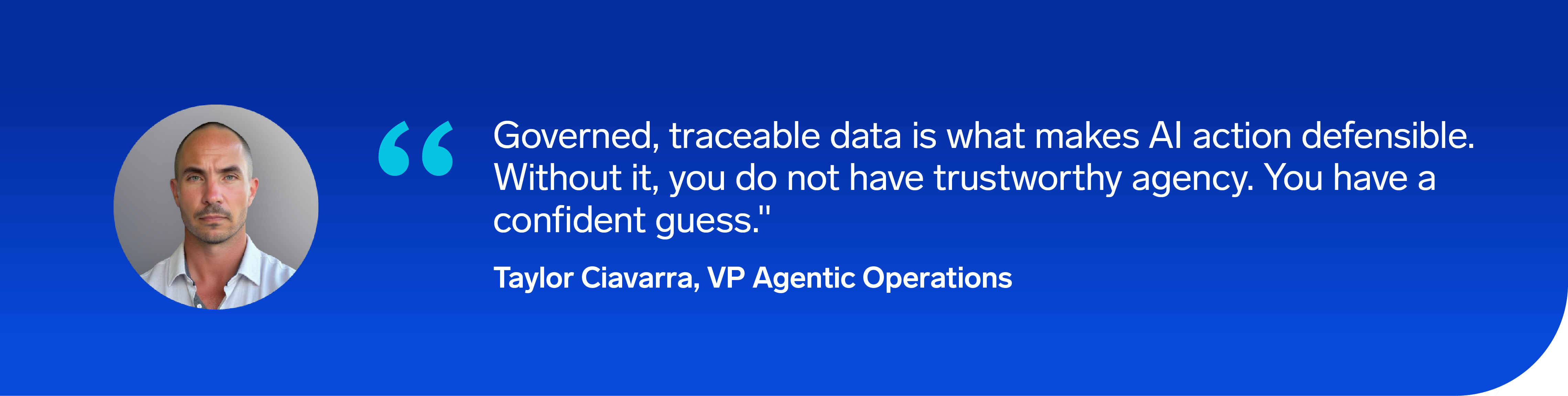
Taylor Ciavarra is VP Agentic Operations at Advisor360°.

Watch my full conversation: AI in Wealth: What’s Real, What’s Next with James Cantwell, Founder of WealthTech Select and host of the AI for Advisors podcast.

Schedule a conversation with Advisor360° to see how AI teammates are transforming the advisor workday. And for more on the research we discussed in the webinar, download Advisor360°’s free 2026 Connected Wealth Report.

AI Needs More Than a Single Pane of Glass

AI Needs More Than a Single Pane of Glass

As wealth management moves from AI assistance to AI action, firms need more than a unified view—they need a trusted data foundation.

Read More
AI Governance Isn't a Constraint. It's a Strength.

AI Governance Isn't a Constraint. It's a Strength.

The wealth management industry has spent the last few years wondering whether to adopt AI. That debate is over. The next one—how to govern it—is just...

Read More
The Advisor Empowerment Era is Here: Webinar Insights and Takeaways

The Advisor Empowerment Era is Here: Webinar Insights and Takeaways

Advisors are increasingly choosing technology based on one question: does it help them grow, or hold them back? The answer is changing how and where...

Read More