Rob Bateman
Advisors are increasingly choosing technology based on one question: does it help them grow, or hold them back? The answer is changing how and where advisors choose to work.
That was the throughline of our recent webinar, Advisor Experience: Knowing Your Value, Owning Your Workday, where I spoke with Jason Diamond, President of Diamond Consultants, and Trevor Hicks, CTO for the RIA Segment at Advisor360°, in a webinar hosted by Davis Janowski, Senior Technology Editor at Wealth Management. We covered advisor mobility, the broken workday, and how AI is starting to change the industry. What follows are takeaways and some of the sharpest thinking Jason and Trevor brought to the table.
Watch the full webinar replay here.
Advisor Mobility Is More Than Movement. It’s Leverage.
More than 11,000 advisors changed firms in 2025 , up roughly 16% from the prior year. In our webinar poll, attendees were nearly split on what that means for the industry: 40% said advisor mobility is healthy because competition benefits advisors and clients, while 36% believe too much movement can disrupt client relationships.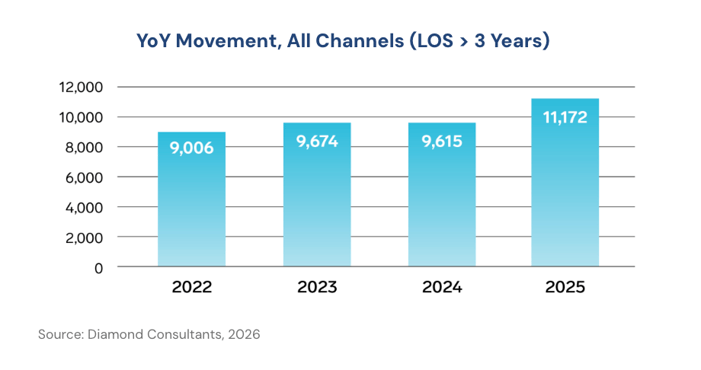 Both views can be true. Movement can be disruptive. But it’s also a sign that advisors are no longer accepting operating models that limit their growth, client experience, or ability to run the business they want to build.
Jason framed the market in terms of “pushes and pulls.” Advisors may be pushed away by outdated technology, compliance friction, limited investment access, or a lack of flexibility. But increasingly, they are also being pulled toward something better: stronger culture, capabilities, economics, and a technology environment that’s built for how they want to work.
His main point sums things up nicely: “He or she who controls the assets has the real power.”
That power comes from the client relationship. Advisors who own trusted relationships with clients are not just employees managing a book. They are business builders with options. They can evaluate firms, platforms, and technology partners through a more strategic lens: Will this help me serve clients better? Will it help me grow? Will it give me freedom, or will it slow me down?
The Advisor’s Book Has Become a Business
One reason the mobility conversation has changed is that advisors are thinking differently about what they’ve built. A high-quality book of business is no longer viewed only as a career income stream. It is increasingly seen as an enterprise asset.
Jason noted that institutional capital has poured into wealth management because the broader market has recognized what advisors have always known: these are durable businesses with meaningful long-term value. That has changed the psychology of the advisor. More advisors are thinking like CEOs, asking whether their firm is helping or hindering the value of the business they are building.
Trevor added a practical nuance to that point: When a high-value advisor joins a firm and wants to bring along a preferred platform, the question the firm should ask is not simply, “Can we accommodate it?” The better question is, “Does this move us toward the firm we are trying to become?”
The answer is not about unlimited technology customization. It is a more advisor-centric foundation: flexibility where it matters, strong governance where it is required, and a technology environment that supports both enterprise scale and individual advisor productivity.
Technology Levels the Playing Field. Integration Is the Obstacle.
Technology has created more choice for advisors, giving them a broader set of models and firm types to consider, including the ability to launch their own RIA. As Jason put it, “A cutting-edge RIA can do it with a laptop and subscription services. And that is a very new thing.”
But choice has a cost. The point-solution boom has created fragmentation. Trevor captured the tradeoff: implemented well, technology reduces friction and gives advisors more time with clients. Implemented poorly, it creates disconnected data, complexity, and the swivel-chair effect that forces advisors to become the integration layer.
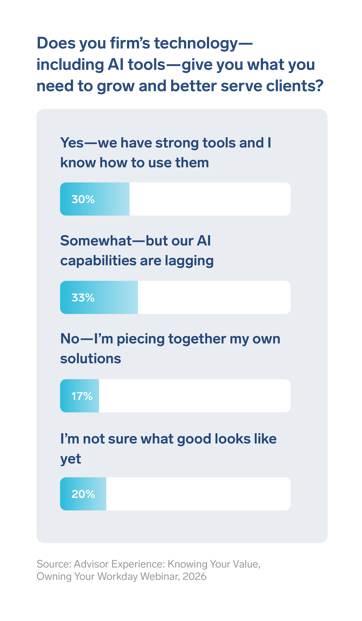
That issue is not a lack of tools, but a lack of shared context. Advisors still switch between systems and need to re-key data that should move sight-unseen across systems. Only 30% of webinar poll respondents said their technology supports growth and better client service. That’s not a technology problem in isolation. It is a growth problem.
AI Is Moving From Hype to Accountability
Advisors are no longer asking whether AI matters, they are asking whether their firm’s AI investments are improving their workday. The first wave—AI meeting notetakers—has gone mainstream and delivered real results. But notetaking is the entry point, not the destination.
The next frontier is agentic AI: autonomous workflows that act on data without waiting for a human to initiate every step. As Trevor pointed out, Agentic AI only works if the underlying data is unified. If your systems disagree on a client’s address, or a planning tool reflects different holdings than your portfolio system, automation scales the problem instead of solving it.
Excited about AI, but not sure where to start? Check out the Advisor360° AI Action List for firms looking to build the trust framework required for AI to scale
Jason centered the topic around questions every advisor should be asking any firm they may join: Is this firm on the cutting edge? Will they allow me to do what I need? Are they a tailwind, not a headwind?
That framing is shifting how advisors think about where they want to work, and the pressure on firms will only intensify.
The Recruiting War Is Already About Technology
I asked Trevor to describe what a genuinely good advisor workday looks like. His answer: “The best technology experience is invisible to the advisor. The least amount of friction, the least amount of diversion from servicing the client, information at their fingertips.”
Invisible technology. That’s the goal. A unified operating environment that surfaces what’s needed and gets out of the way. The firms that win the next decade of advisor talent will be the ones with the most coherent, advisor-centric operating environments.
At Advisor360°, that is the north star we are building toward: an advisor experience that is genuinely integrated, intelligent, and genuinely built around the advisor’s workday. The advisors sitting on quality books of business have more leverage than they realize. The question is whether their firm is putting wind at their back, or asking them to run into it.
Watch the full webinar replay: Advisor Experience: Knowing Your Value, Owning Your Workday
Schedule a conversation with Advisor360° to see how we’re transforming the advisor workday. And download the 2026 Connected Wealth Report to explore the trends shaping the future of advice.
Robert Bateman is Director of Product Marketing at Advisor360°