Darren Tedesco
AI isn’t coming to wealth management—it’s already here.
That was my biggest takeaway from this year’s T3 conference in New Orleans, where the conversation made one thing clear: the industry is moving quickly from experimenting with AI to embedding it into the infrastructure of how advisory businesses operate.
T3 has long been one of my favorite industry events because it brings founders, engineers, operators, and go-to-market leaders together in one place. Conversations move quickly from business models to product design to partnerships, and occasionally just geeking out about the technology itself.
This year’s conference was one of the best I’ve attended. I was especially proud that Advisor360° had the opportunity to contribute two general sessions and spend time connecting with so many individuals across the ecosystem.
For those who couldn’t make it to New Orleans, here are a few observations that stood out.
AI Is Moving From Feature to Infrastructure
What became clear throughout the conference was that the industry conversation around AI has fundamentally shifted.
A year or two ago, AI was still largely a curiosity—something vendors were experimenting with or demoing. At T3 this year, it felt different. AI is increasingly being discussed as core infrastructure for how advisory businesses will operate, not just a feature layered onto existing tools.
According to Advisor360°’s 2026 Connected Wealth Report, 72% of advisors say their firm’s technology is outdated or in need of an upgrade, with the biggest frustrations being a lack of AI-enabled capabilities and poor integration across systems.
That dovetails with the broader conversation moving beyond AI features toward AI-native platforms designed around the advisor workday. Large language models have crossed a reliability threshold where they can perform meaningful work, not just assist with it.
These shifts will have long-term implications for how advisor businesses scale.
Practical AI Is Finally Showing Up
Another encouraging shift at T3 was the move from theory to application. The conference introduced its first AI University track, focused on practical use cases.
What stood out was the emphasis on real-world implementation rather than speculation about what AI might someday do.
One example was Oasis Founder and CEO John O’Connell demonstrating how AI can assist with portfolio construction and risk analysis. These weren’t hypothetical ideas. They were working tools solving real problems.
At the same time, the rise of “vibe coding”—building applications on the fly using AI—sparked a lot of discussion. The ability to rapidly prototype tools is exciting, but it also raises an important question the industry is just beginning to grapple with: Just because AI can build something…should it?
As the technology becomes easier to deploy, governance and thoughtful implementation will become just as important as innovation.
Advisors Are Already Using AI—More Than Many Realize
Another theme from hallway conversations was just how widely AI is already being used by advisors. Tools like ChatGPT and Claude came up repeatedly in conversations. Advisors are using them for things like client communication, marketing content, editing, summarization, and research.
Meanwhile, AI meeting notetakers, including our own Parrot AI, remain the most widely adopted category by far. Automating meeting documentation and follow-up is a natural first step because it saves time without disrupting how advisors work.
The broader data supports what we’re hearing in the field. In the 2026 Connected Wealth Report, 2026 Connected Wealth Report, 74% of advisors say AI represents an advantage rather than a threat to their business.
At the same time, advisors want to remain firmly in control. Ninety-three percent say they want the final say over AI-generated outputs, highlighting the importance of designing AI systems that augment human expertise rather than replace it.
The future of advice will almost certainly involve both.
The WealthTech Tool Explosion
Wealth management technology has always been fragmented, but the number of solutions in the market today is staggering.
I had a great conversation with Michael Kitces about whether we’ll see more point solutions or fewer over the next five years.
My personal view is that many of today’s vertical point solutions will eventually collapse into broader platforms, where AI teammates perform work that currently requires multiple tools. That transition won’t happen overnight. For the foreseeable future, firms will continue navigating an ecosystem filled with both innovative startups and established platforms.
The challenge for advisors will be cutting through the noise and identifying which technologies actually improve the advisor experience rather than adding more complexity.
The Next Wave: Agentic AI
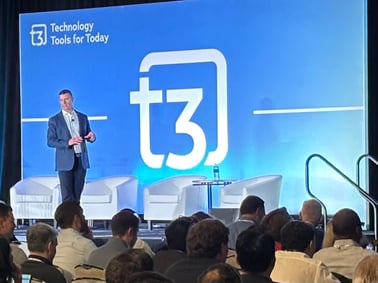 In many ways, T3 didn’t introduce new ideas, it confirmed how quickly those ideas are becoming reality. Prompt-based tools and notetakers are just the beginning. The next frontier is agentic AI—systems that can execute workflows across the advisor stack.
At T3, Mike Viscariello and I shared a look at Advisor360°’s newest AI teammates, designed to automate workflows like meeting preparation and other high-frequency advisor tasks.
Where this gets particularly interesting is the data layer. Over time, AI systems will begin learning from the behaviors and workflows of top-performing advisors, surfacing insights and best practices across the platform. Companies with long-standing platform data may have a meaningful advantage because they have the historical context needed to train these systems responsibly.
That’s why the future of AI in wealth management isn’t just about smarter tools—it’s about smarter operating environments.
Looking Ahead
By the time T3 returns in 2027, this time in Las Vegas, the wealth management technology landscape could look very different. The firms that lead won’t necessarily be the ones adopting the most AI tools. They’ll be the ones redesigning the advisor experience around intelligent workflows so technology removes friction instead of adding to it.
And honestly, that’s part of what makes this industry such an exciting place to build right now.
Schedule a conversation with Advisor360° or book a Parrot AI demo to see how AI teammates are transforming the advisor workday. And download the 2026 Connected Wealth Report to explore the trends shaping the future of advice.
Darren Tedesco is President at Advisor360°