Advisors act as the integration layer across siloed tools, at a significant cost to their time. AI is about to change that.
An advisor’s biggest operational burden today isn’t complexity in the markets. It’s complexity in their tech stack. Much of the day is spent toggling between systems, searching for information, and stitching together context from multiple sources. Advisors effectively function as the human integration layer between their tools...and that eats up hours that could be spent with clients.
In this month’s Connect360° newsletter, we explore how intelligent automation is reshaping the advisor workday: where time is lost, what’s starting to improve, and how firms can start to help advisors reclaim precious time in their day.
The Advisor’s Day Is Fractured by Context Switching
If the advisor workday feels fragmented, it’s because it often is. The issue is the accumulated cost of context switching: jumping between onboarding systems, financial analysis tools, custodian portals, and other niche solutions that don’t meaningfully communicate with each other.
Matt Sonnen, Chief Operating Officer of Coldstream Wealth Management, sees the challenge firsthand inside advisory firms. Advisors, he explains, “spend a significant portion of their day searching for data across siloed systems” as they prepare for meetings and manage ongoing client work.
That means logging into one system for meeting notes, another for portfolio activity, and another to check a client’s financial plan. No single system holds the complete picture. The advisor does—in their head.
Michael Silver, Founder and Managing Director at Alpha Scale, says that role design is a key part of the problem. “Advisors don’t lose time because they aren’t productive. They lose time because they’re doing work that should be delegated.”
Preparation, documentation, and internal coordination gradually crowd out the time advisors could spend in discovery, strategic advice, and relationship expansion—the work that actually promotes growth.
AI’s Impact on Wealth Management Is Structural
If the last major wave of wealthtech digitized processes, the next wave will use AI to divert manual tasks away from advisors. But there’s an important caveat. Most of what gets labeled “AI” in wealth management today is assistive: summarize this transcript, draft that email. Those are useful, but they are not transformational.
The structural shift happens when AI moves from assisting with tasks to executing workflows across systems. Rather than summarizing a single document before a client meeting, an AI agent can pull together portfolio data, CRM notes, planning documents, and more into a unified briefing for the advisor to refine. That’s a fundamentally different type of capability than, say, a better search bar.
The time savings here won’t come from “replacing” advisors, it will come from compressing the manual work that surrounds the advice itself. Tasks that once consumed large parts of the day (meeting transcriptions, follow-up emails, CRM updates, first drafts of proposals) are increasingly being automated.
Sonnen says the potential is significant, though still emerging. “The long-term vision is promising,” he says. As data quality and integration improve, AI agents should begin eliminating the silos that slow advisors down.
Meeting preparation that once took an advisor an hour or more of navigating systems becomes fifteen minutes spent refining strategy. The manual work begins to fall away, and the advisor gets to be the advisor.
Automation Works When the Data Foundations Are Sound
Despite the excitement around intelligent automation, most firms still face a fundamental challenge: readiness. Successful automation depends less on the tools themselves and more on the surrounding operating environment—clean data, defined workflows, trusted outputs. Most firms underestimate how structural that challenge really is.
Sonnen states it directly: “Many RIAs believe that layering an AI tool on top of disorganized or incomplete data will deliver meaningful results.” But if the underlying data is inconsistent or scattered across systems, no AI tool will generate useful insights. The model scales whatever it’s given—including a mess.
AI requires clean, well-governed data and a common structure for households, accounts, and client history. That means your systems need to agree on what a “household” is, who belongs to it, and who’s entitled to see what. If your AI can’t explain what data it used, what version of a definition was in effect, and who was entitled to see it, the outputs may look complete while containing errors no one catches until it matters.
In wealth management, the stakes around this are high. Regulators won’t ask whether the AI output looked right at the time. They will expect firms to own the information they send to clients and the insights they use to serve them. With that in mind, auditability and explainability have to be designed in from the start.
Sheikowitz put it plainly: “Automation doesn’t fail because of AI. It fails because of ambiguity.”
That idea is more important than ever today. When roles are unclear, and the definition of “household” means something different in your CRM than it does in your planning tool, automation amplifies the confusion rather than resolving it.
The fragmentation that was tolerable when advisors were the integration layer becomes a greater liability once AI is operating at speed across those same systems.
How to Redesign the Advisor Workday
Automation delivers real value when it’s embedded into the advisor’s workday, rather than layered on top of existing processes.
At Advisor360°, this is the design principle behind our agentic teammates: AI that operates across the advisor workflow, not just within a single task. From meeting preparation through follow-up, these agents deliver just-in-time information, reduce friction, and unify the advisor experience across systems. They verify document completeness before submission rather than requiring manual cleanup after rejection. They assemble briefings so the advisor walks in prepared, rather than spending hours pulling context from five different places.
The goal is a fundamentally different workday. One where advisors spend less time navigating technology and more time delivering meaningful advice and building stronger client relationships.
Schedule a conversation with Advisor360° to see how AI teammates are transforming the advisor workday. And download the 2026 Connected Wealth Report to explore the trends shaping the future of advice.
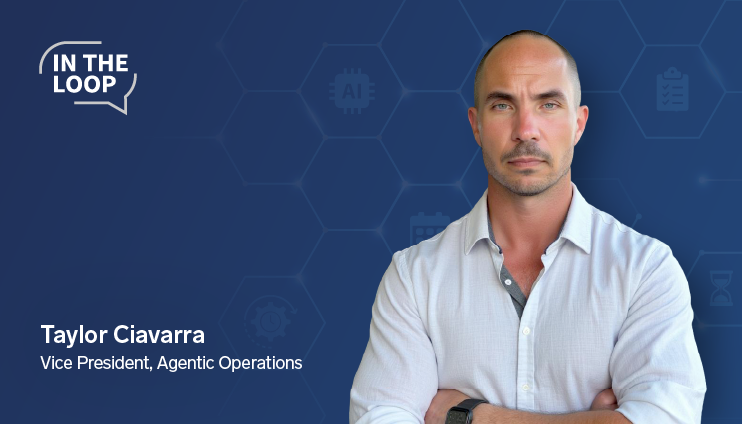
Taylor Ciavarra is VP, Agentic Operations at Advisor360°
This Month’s Contributors
-
Eric Sheikowitz, Managing Director, Alpha Scale
-
Michael Silver, Founder and Managing Director, Alpha Scale
-
Matt Sonnen, Chief Operating Officer, Coldstream Wealth Management